Everything US Fitness Brands Need to Know Before Ordering Custom Gym Wear
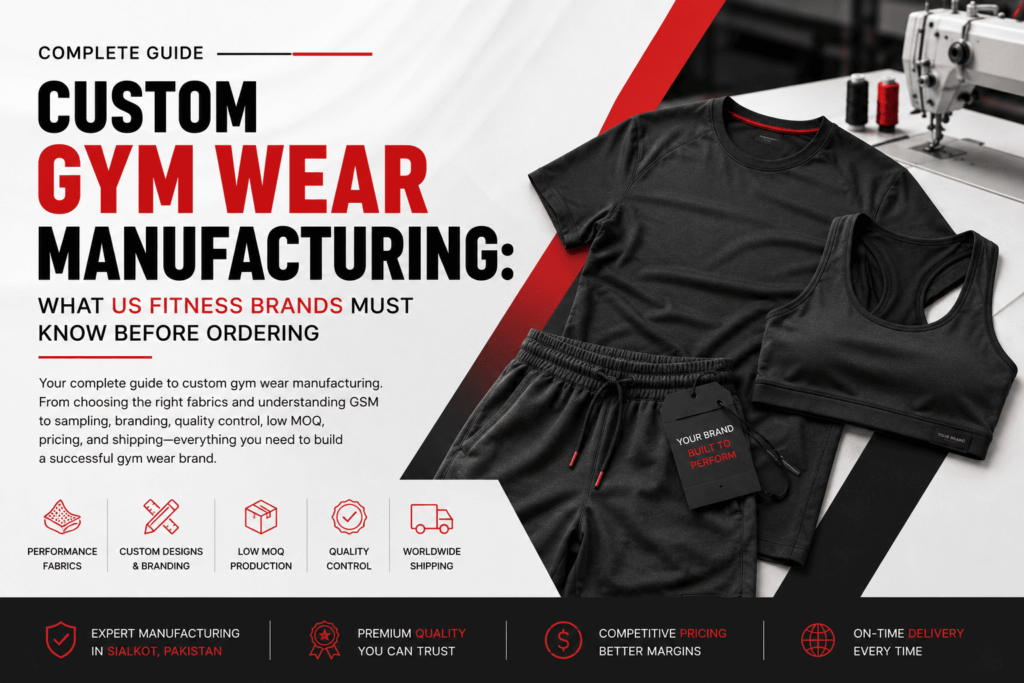
Custom Gym Wear Manufacturing: What US Fitness Brands Must Know Before Ordering
Every year hundreds of gym wear and fitness apparel brands launch in the United States. Some of these brands are started by gym owners who want to add merchandise, while others are started by trainers and athletes who want to turn their personal brand into a full apparel line. What separates the brands that do well from the ones that don’t comes down to how well they understand the manufacturing process before they place an order for custom gym wear.
This guide covers everything a US fitness brand needs to know before working with a custom gym wear manufacturer. Whether you are a gym owner, a trainer, or an independent apparel founder, this guide will help you understand the process of creating custom gym wear, from choosing the right fabric to getting the final product delivered to your customers.
1. Why Custom Gym Wear Is Different From General Apparel Manufacturing
Gym wear is not just clothing, it is performance equipment. It needs to move with the body during exercises like squats, deadlifts, sprints and stretches without restricting movement. Custom gym wear manufacturing requires a higher level of technical understanding than producing a basic t-shirt or hoodie. This is why choosing a manufacturer with sportswear experience makes a real difference in the final product.
2. Know What Kind of Gym Wear Brand You’re Building
Before contacting any manufacturer you need to get specific about your product category. Different gym wear categories require different manufacturing expertise — for example, compression wear, studio and yoga wear, streetwear-style gym apparel, team and gym-branded uniforms, and combat sports training gear all require different types of fabric and construction methods.
- Compression wear is built for support during heavy lifting or high-intensity training
- Studio and yoga wear is made with softer, seamless fabrics that prioritize flexibility and a second-skin feel
- Streetwear-style gym apparel is designed to look good outside the gym as much as inside it
- Team and gym-branded uniforms are bulk orders of branded shirts, shorts or training kits for gym staff or members
- Combat sports training gear is built for boxing, MMA and grappling
Being clear about your category from the start helps your manufacturer recommend the right fabric and construction methods, and prevents costly redesigns later.
3. The Fabric Conversation You Need to Have Before Anything Else
Fabric selection is the most important technical decision in custom gym wear manufacturing. US fitness brands should understand the fabric categories, including polyester-spandex blends, nylon-spandex blends, moisture-wicking polyester, and French terry and fleece blends. You should also ask your manufacturer about squat-proof (opacity) testing, since see-through fabric under stretch is one of the most common quality complaints in the gym wear category.
4. Understanding GSM and Why It Matters
GSM, or grams per square meter, is the standard measurement for fabric weight. It directly affects how a product performs and feels. Lighter fabrics are common for warm-weather training tops, while heavier fabrics are typical for leggings and shorts. You should ask your manufacturer to specify the GSM for each fabric option they offer, and request a swatch to see how the fabric actually feels and performs.
5. Minimum Order Quantity: The First Real Filter for Choosing a Manufacturer
Minimum order quantity, or MOQ, is often the deciding factor in which manufacturer you can work with. Look for manufacturers who offer low MOQ per style and per color, rather than one large combined minimum. You should also look for manufacturers who offer sample-first production, so you can approve a physical unit before committing to bulk. This approach lets you test designs in small batches, see what resonates with your customers, and then place larger orders on the designs that work.
6. Why Sialkot, Pakistan Has Become a Go-To Region for Gym Wear Manufacturing
Sialkot has manufactured sports goods and apparel for global brands for generations. The factories in Sialkot have developed specialized expertise in sportswear, gym wear, and leather sporting goods. For a US fitness brand, this specialization means working with a factory where technical details like compression fabric performance, flatlock stitching, and moisture-wicking treatments are core competencies.
7. What a Proper Sampling Process Should Look Like
A proper sampling process should include fabric swatch approval, a pattern and fit sample, a stitching and construction review, revision rounds, and sign-off before bulk production. You should receive physical fabric swatches to approve color, weight and stretch, and you should try on a sample to evaluate movement, length and comfort during actual training movements — not just standing still.
8. Grading: A Step Many New Brands Underestimate
Once your base sample is approved, your manufacturer needs to grade the pattern across your full size range. Poor grading is one of the most common causes of inconsistent sizing across a product line. You should ask your manufacturer directly how they handle size grading, and whether they can provide a size chart with actual body measurements.
9. Branding, Logos and Custom Details
Custom gym wear brands add branding through embroidery, screen printing, heat transfer, or woven labels and hang tags. You should ask your manufacturer which methods they offer in-house versus what they outsource, as in-house capability generally means faster turnaround and more consistent quality control.
10. Quality Control: What to Ask Before You Place a Bulk Order
Quality control is where trust is built or broken with a manufacturing partner. Before placing your bulk order you should ask specifically about their inspection process, seam strength testing, and color consistency. You should also ask about their process for handling defects and returns, as this will give you a sense of their commitment to quality and customer satisfaction:
- What happens if a problem is found with your order after it ships — is there a way to fix the issue?
A manufacturer that gives you direct answers to your questions is usually a better partner to work with in the long run.
11. Figuring Out Prices for Your Custom Gym Wear
Once you know how much it costs to make each item, you can set your prices from there. A common way to do this is:
- Cost to make each item (this includes the cost of fabric, labor and other things like threads and labels, plus the profit the factory makes)
- Cost to get the items to you (this includes the cost to make each item, plus the cost to ship them to you, pay duties and handle imports)
- Price you sell to businesses (if you sell to gyms or stores — usually 2 to 2.5 times the cost to get the items to you)
- Price you sell to customers (usually 3 to 4 times the cost to get the items to you, so you can make a profit after paying for marketing and other costs)
Many fitness brands do not realize they are not making as much money as they thought, because they forget to include the cost to ship items and pay duties when they calculate their prices.
12. Shipping From Pakistan to the United States
Understanding how shipping works can help you avoid surprises when you launch your products. Here is a general idea of what to expect:
Time to make the products: It usually takes two to four weeks to make the products after you approve the samples, depending on how big your order is and how complicated it is.
Shipping by air: This is faster, usually taking five to ten days. It costs more per item. It is better for smaller orders or when you need the products quickly.
Shipping by sea: This is more cost-effective for larger orders, but it takes longer, usually four to six weeks, depending on where the products are going and how long it takes to clear customs.
Customs and duties: When you import custom gym wear into the US, you have to pay duties based on what the products are made of and how they are classified. Your manufacturer should help you understand what documents you need and what codes to use, so you can get the products through customs smoothly. You can find information about shipping on our shipping policy page.
13. Communication: The Key to Success in Manufacturing
Working with someone in a different time zone, and possibly speaking a different language, can be challenging. The brands that have the best experience are the ones that communicate clearly. They provide detailed pictures, exact measurements and written confirmation of decisions instead of just talking about them. A manufacturer that responds quickly, asks questions to clarify, and confirms details in writing before starting production is showing you they are reliable and a good partner. You can see how we communicate and work on our About page.
14. Testing Before You Grow
Do not rush to place an order for all the products you want to sell. Instead:
- Start with a small group of products — three to five styles instead of fifteen
- Order a small quantity of each style to see how well they sell
- Use the sales data to decide what to reorder and what to make more of
This approach helps you avoid losing money and lets your manufacturing relationship grow naturally with your brand.
15. Common Mistakes US Fitness Brands Make When Ordering Custom Gym Wear
- Approving designs without seeing a sample of the fabric
- Not testing how the products fit when you are moving, not just standing still
- Choosing the cheapest fabric without thinking about how durable and opaque it is
- Ordering too many sizes and colors at first instead of seeing what sells
- Not including shipping and duties in your price calculations
- Working with a manufacturer that will not give you a physical sample before making a big order
16. Making a Process to Reorder Products
Once you have tested your first group of products, you can see how well your manufacturing relationship works when you need to order more. Keep records of your approved specifications, fabric sources, sizing charts, and any changes you made during your first order. This will help you get consistent quality every time you order more products, and it will make it easier to add new products with the same manufacturer.
17. Growing Your Product Line
As your fitness brand grows, working with a manufacturer that can make different types of products — like leather accessories, streetwear and combat sports gear, in addition to your core gym wear line — lets you expand your catalog without having to work with many different factories. This makes it easier to control quality, shipping and communication as your brand’s product line grows.
Frequently Asked Questions
What is a good minimum order quantity for a new gym wear brand?
This varies by manufacturer, but look for factories that let you order a small quantity to start, so you can test your designs without committing to a large order.
How can I be sure a fabric will not be see-through before I order a lot of it?
Ask for a physical sample and test it yourself by stretching and moving in it. The weight and type of fabric can give you an idea, but trying it out is the best way to know for sure.
Can one manufacturer make both gym wear and leather accessories for my brand?
Yes, if they have different departments for each type of product, it can simplify your supply chain and make things easier for you.
How long will it take to get my order from the start to when I receive it in the US?
It usually takes one to two weeks to make the sample, two to four weeks to make the bulk order, and then five to ten days by air or four to six weeks by sea to ship it to you.
Final Thoughts
Making custom gym wear is a process that rewards fitness brands that take their time at the start — choosing the right fabric, getting a physical sample, and checking the manufacturer’s quality control process, even if it feels like it is taking too long to launch. The brands that build a strong reputation are the ones that treat their first production run as the foundation for everything that follows, not just something to get out of the way before opening their store.
Ready to make your custom gym wear line?
Pritex Sports is a custom sportswear and gym wear manufacturer based in Sialkot, Pakistan, that offers sample-first production, low minimum order quantities, in-house fabric sourcing, branding and quality control, with shipping worldwide to fitness brands in the United States. You can learn about our capabilities on the Shop page, learn about our facility on the About page, and when you are ready to start your project, contact us. We usually respond within one business day.