Minimum order quantity has quietly ended more independent apparel brands before they even launched than almost any other factor in the manufacturing process. A founder finds a design they love, reaches out to a manufacturer, and discovers the minimum order is 2,000 units per style — an amount of capital and inventory risk that simply doesn’t make sense for a brand that hasn’t sold a single item yet. This guide explains what low MOQ manufacturing actually means, why it’s changed the playing field for small brands, and how to use it strategically to compete with much larger, established sportswear labels.
If you’re an independent founder trying to figure out how to source a low MOQ custom sportswear line without the budget of a major label, this is the complete breakdown of how to do it right.
- What MOQ Actually Means and Why Factories Set It
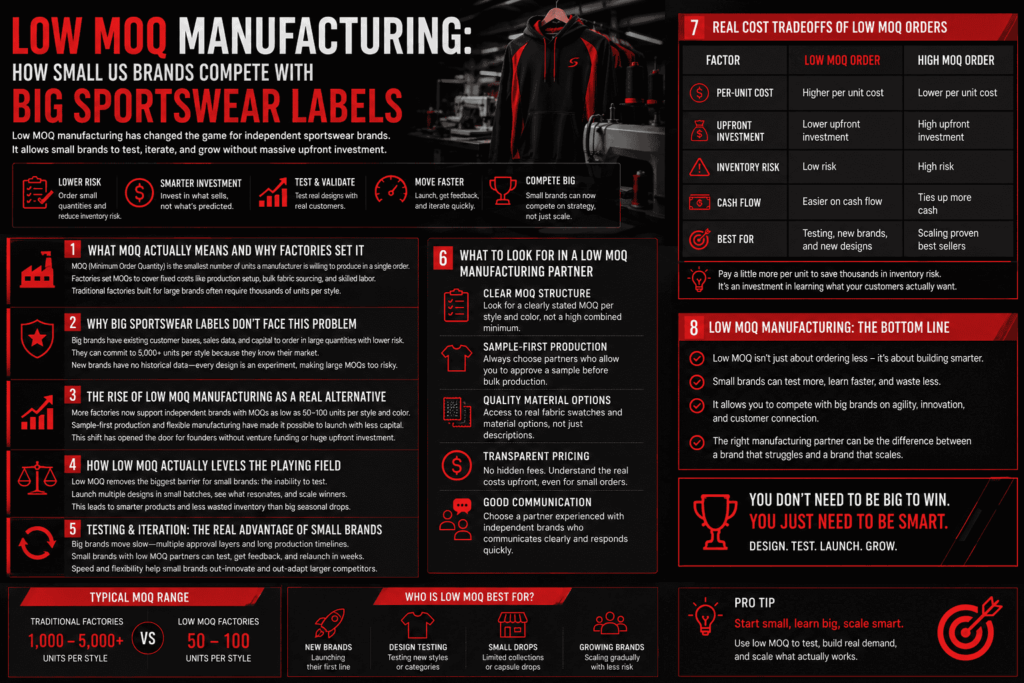
Minimum order quantity is the smallest number of units a manufacturer is willing to produce in a single order. Factories set MOQs for practical reasons — setting up a production line, sourcing fabric in bulk, and allocating skilled labor all involve fixed costs that need to be spread across enough units to make the order worthwhile. A factory built primarily around large corporate clients naturally sets MOQs that make sense for those clients — often in the thousands of units per style — because that’s who they’ve built their production process to serve.
This isn’t a flaw in the system; it’s simply a mismatch between traditional factory models and the reality of how new, independent brands actually need to operate: testing designs in small batches before committing to scale.
- Why Big Sportswear Labels Don’t Face This Problem
Major sportswear labels have existing customer bases, sales data from previous seasons, and enough capital to absorb the risk of a large production run even if a specific design underperforms. They can order 5,000 units of a new legging style with reasonable confidence because they already know roughly how their audience responds to similar products. A new, independent brand has none of that historical data — every design is essentially an experiment, which makes committing to a large MOQ significantly riskier in proportion to the brand’s available capital.
- The Rise of Low MOQ Manufacturing as a Real Alternative
As the number of independent, direct-to-consumer apparel brands has grown dramatically over the past decade, manufacturing has adapted to serve them. A growing number of factories — particularly ones that have recognized independent brands as a real, valuable customer segment rather than just an inconvenience — now offer significantly lower MOQs, sometimes as low as 50 to 100 units per style and color, along with sample-first production. This shift has made it genuinely possible for a founder with a modest budget to launch a real apparel brand without needing venture funding or a large personal investment upfront.
- How Low MOQ Actually Levels the Playing Field
Low MOQ manufacturing doesn’t make a small brand’s product identical in scale to a major label’s — but it removes the single biggest structural disadvantage independent founders face: the inability to test. With low MOQ access, a small brand can launch three or four different designs in small batches, see which ones actually resonate with real customers, and reinvest in scaling up the winners — essentially running the same kind of market testing a major label runs internally with focus groups and sales forecasting, just using real market data instead. This iterative approach often leads to a more precisely tuned product line than a large brand achieves with a single big seasonal drop.
- Testing and Iteration: The Real Competitive Advantage of Small Brands
Large sportswear labels move relatively slowly by necessity — decisions go through multiple layers of approval, and production commitments are planned months or seasons in advance. A small brand with a low MOQ manufacturing partner can move dramatically faster: testing a new design, gathering direct customer feedback, and having a revised or entirely new product back in production within weeks rather than months. This speed advantage is one of the clearest ways small brands genuinely outcompete larger labels, rather than simply imitating them at a smaller scale.
- What to Look for in a Low MOQ Manufacturing Partner
Not every manufacturer advertising “low MOQ” delivers the same level of quality or service. When evaluating a potential partner, look specifically for:
A clearly stated MOQ per style and color, rather than a large combined minimum across your whole order
Sample-first production, so you approve a physical unit before any bulk commitment
Fabric and material options with real swatches available, not just descriptions
Transparent pricing that doesn’t penalize smaller orders with hidden fees or dramatically worse per-unit costs
Clear communication and a track record of working with independent and growing brands, not just large corporate clients
- Understanding the Real Cost Tradeoffs of Low MOQ Orders
It’s worth being honest about the tradeoffs: per-unit costs on a low MOQ order are typically higher than what a major label pays on a 5,000-unit order, because certain fixed production costs get spread across fewer units. This is a normal and expected part of manufacturing economics, not a sign that you’re being overcharged. The key is understanding your full landed cost — manufacturing, shipping, and duties — and pricing your product accordingly, rather than trying to compete directly on price with a major label whose economics of scale you simply don’t have access to yet.
- Why Sialkot, Pakistan Has Become Especially Accessible for Low MOQ Brands
Sialkot’s sports goods and apparel manufacturing industry has deep roots serving major international brands for decades, but as demand from independent founders and small brands has grown, many factories in the region have adapted their production models to serve this segment directly, offering low MOQ, sample-first production alongside their larger-scale capabilities. This means a small US brand can access the same specialized craftsmanship — leather cutting, precision stitching, technical sportswear fabric expertise — that major labels have relied on for years, without needing to place an order at anywhere near that scale.
- Building a Product Roadmap Around Low MOQ Testing
A practical way to use low MOQ manufacturing strategically is to build your product development around a repeatable testing cycle: design two to three variations of a core product, order the minimum quantity of each in a couple of key sizes, launch and gather real sales and feedback data, then scale up production on whichever version performed best while retiring or revising the others. Over a year, this cycle lets you develop a genuinely data-informed product line, rather than betting your entire budget on a single untested design.
- Sample-First Production: The Foundation of Low MOQ Success
Low MOQ only works well when paired with a proper sample-first process. Before committing to even a small bulk order, you should receive a physical sample to check fabric feel and weight, stitching and construction quality, fit and sizing accuracy, and how your branding actually looks on the finished product. Skipping this step to save time is one of the most common mistakes small brands make, and it defeats much of the risk-reduction benefit that low MOQ manufacturing is supposed to provide in the first place.
- How Low MOQ Changes Your Cash Flow and Growth Strategy
One of the most underappreciated benefits of low MOQ manufacturing is what it does to your cash flow. Instead of tying up a large amount of capital in a single big inventory bet, you can reinvest revenue from an early, smaller batch directly into your next production run. This creates a more sustainable growth cycle for a bootstrapped or lightly funded brand — each successful product funds the next one, rather than requiring a large upfront capital raise before you’ve proven the brand has real demand.
- Branding and Differentiation When You Can’t Compete on Scale
Since small brands generally can’t compete with major labels on price or production scale, differentiation has to come from somewhere else — usually a combination of a genuinely specific niche, strong visual branding, authentic storytelling about the product and its origin, and direct relationships with your customer base through social media and community building. Low MOQ manufacturing supports this strategy well, because it lets your product line stay tightly aligned with a specific niche audience rather than needing to appeal broadly enough to justify a massive production run.
- Quality Control Still Matters at Small Scale
It’s a mistake to assume quality control matters less on a small order — if anything, it matters more, because a small brand has less room to absorb the reputational damage of a defective product reaching an early, engaged customer base. Ask your manufacturer how they handle quality inspection even on smaller production runs, and don’t assume a lower MOQ means lower attention to detail from a serious manufacturing partner.
- Scaling Your Order Size as Your Brand Grows
Low MOQ manufacturing isn’t meant to be a permanent ceiling — it’s meant to be a starting point. As specific designs prove themselves through repeat sales, gradually increasing your order quantity on those winning products typically improves your per-unit cost and margin over time. A good manufacturing partner should be able to scale with you, handling both your early small batches and your larger reorders as your brand grows, rather than being a fit only for one stage of your business.
- Common Mistakes Small Brands Make With Low MOQ Manufacturing
Ordering the maximum variety of colors and styles allowed by the MOQ instead of testing a focused, smaller selection first
Skipping the sample approval stage to save a few days, then discovering quality issues in the full order
Not accounting for the naturally higher per-unit cost of small orders when setting retail pricing
Choosing a manufacturer based purely on the lowest advertised MOQ without vetting quality or communication
Failing to reinvest revenue from a successful first batch into scaling that specific product further
- Low MOQ Across Multiple Product Categories
For a brand that wants to grow across product categories. Like gym wear, streetwear, leather accessories or combat sports gear. Working with a manufacturer that allows low MOQs across multiple in-house departments makes it much easier to test your entire product line. You don’t need to build relationships or deal with different minimum orders for each category. You can check out our production capabilities on the About page.
- Shipping Considerations for Orders
Smaller orders usually take less time to produce. Typically two to three weeks after sample approval. Because the volume is small air freight is often the choice with delivery to the US taking five to ten days. As your order sizes grow over time sea freight becomes more cost-effective though it takes longer. Around four to six weeks. You can find all the details in the Pritex Sports shipping policy page.
- Why This Model Genuinely Threatens Big Labels Market Share
Big sportswear brands built their success on scale. The ability to make quantities at very low per-unit costs. Low MOQ manufacturing doesn’t erase that advantage completely. It removes the big hurdle that once kept smaller more nimble brands out of the game. The result is a rising number of niche brands that are taking market share in categories once ruled by just a few large players. These smaller brands move faster test ideas more precisely and build stronger connections with their audience. That’s something big labels simply can’t match.
- Building Long-Term Manufacturing Relationships From a Start
The brands that grow successfully from a low MOQ start are usually the ones who treat their manufacturer like a long-term partner from the very beginning. Even when you’re ordering quantities. Clear communication, expectations about timelines and consistent follow-up on orders all help build trust. That trust often leads to pricing, more flexibility and priority attention as your order sizes grow.
Frequently Asked Questions
What’s a low MOQ for a new sportswear brand to expect?
It depends on the manufacturer and the product type.. Many factories that work with independent brands now offer MOQs from 50 to 150 units per style and color. Most start with sample- production before any bulk order.
Will my per-unit cost always be higher with a MOQ order?
Generally yes. Compared to a large order. Because fixed costs are spread over fewer units.. That’s a normal tradeoff for the lower risk and more flexibility that low MOQ manufacturing offers, especially when your design is still unproven.
Can I get the quality with a low MOQ order as a big brand gets with a large order?
Yes. Long as the manufacturer applies the same quality standards to every order no matter the size. You should confirm this directly before placing your order.
How do I know when it’s time to increase my order size beyond the minimum?
Look at your sales data. When a specific design sells out repeatedly and your inventory runs low that’s a signal to scale up production on that product.
Final Thoughts
Low MOQ manufacturing has changed the game for who can build a sportswear or apparel brand. It’s no longer for founders with a lot of capital or big label backing. It’s open to entrepreneurs who have a strong niche, a solid product idea and a manufacturing partner willing to work at the right scale. The small brands that use this access well. Testing carefully reinvesting in what works and treating their manufacturer like a long-term partner. Are the ones building lasting competition against brands many times their size.
Ready to launch or grow your sportswear brand with MOQ manufacturing?
Pritex Sports is a custom sportswear, gym wear, streetwear and leather accessories manufacturer based in Sialkot, Pakistan. We offer minimum order quantities, sample-first production and worldwide shipping to independent brands in the United States. Browse our capabilities on the Shop page learn more about our facility, on the page and when you’re ready to start your project contact us. We usually respond within one business day.