Your Step-by-Step Roadmap to Building a Successful Activewear Brand
The United States activewear and gym wear industry has grown into one of the most competitive and fastest-expanding segments of the apparel market. What used to be dominated by a handful of legacy brands is now filled with hundreds of labels. Many started by a single founder with a laptop an Instagram account and a manufacturing partner overseas. If you have ever thought about launching your activewear gym wear, streetwear or leather accessories brand this guide walks you through the entire process from idea to first shipment and everything in between.
This is a detailed guide because starting an apparel brand is not a single decision. It’s a series of smaller decisions that compound into either a smooth launch or a costly frustrating one. We’ll cover niche selection, market research, branding, design, fabric selection, finding and vetting a custom activewear manufacturer understanding minimum order quantities, sampling, quality control pricing your products, shipping and logistics and how to actually launch and sell once your inventory arrives.
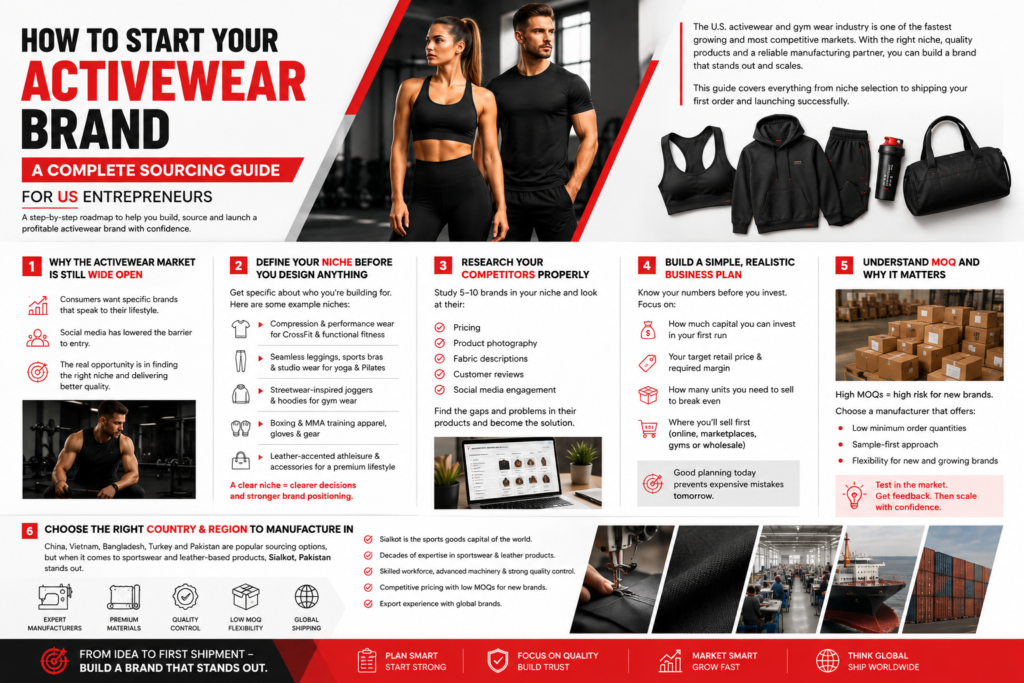
- Why the Activewear Market Is Still Wide Open for New Brands
It might seem like the activewear space is saturated.. In some ways it is.. Saturation at the top (big-box national brands) doesn’t mean saturation everywhere. Consumers today are actively looking for brands that feel more specific to them: a brand built for powerlifters a brand built for yoga instructors a brand built for boxing gyms, a brand that only makes streetwear-style joggers for the gym. The specific your positioning the easier it is to build a loyal audience even if that audience is smaller than a mass-market brands.
Social media has also lowered the barrier to entry dramatically. A founder with an Instagram or TikTok presence and a genuinely good product can build a six or seven-figure brand without ever opening a physical store. The real bottleneck for new founders isn’t marketing. Its finding a reliable manufacturing partner who can produce quality product at a reasonable minimum order quantity.
- Define Your Niche Before You Design Anything
Before you sketch a design or contact a single supplier get brutally specific about who you’re building for. “Activewear for everyone” is not a niche. It’s a recipe for a brand that looks like everyone. Some examples of more defensible niches:
Compression and performance wear for CrossFit and functional fitness athletes
Seamless leggings, sports bras and studio wear for yoga and Pilates practitioners
Oversized streetwear-inspired joggers and hoodies designed specifically for gym wear
Boxing and MMA training apparel, gloves and gear for combat sports gyms
Leather-accented athleisure and accessories for a premium lifestyle-driven audience
Once you know your niche, everything fabric choice, fit, price point, marketing tone. Becomes far easier to decide because you’re designing for a specific person rather than guessing at a general audience.
- Research Your Competitors Properly
Spend time studying five to ten brands that are already serving your intended niche. Look at their pricing their product photography, their fabric descriptions, their customer reviews and their social media engagement. Pay attention to complaints in reviews. Sizing issues, fabric pilling, poor stitching. Because these are exactly the gaps you can fill with a better product. Competitor research isn’t about copying; it’s about understanding what the market already expects so you know where you can stand out.
- Build a Simple Realistic Business Plan
You don’t need a fifty-page business plan to start an apparel brand but you do need clarity on a numbers before you place your first order:
How much capital you can realistically invest in your first production run
Your target retail price per item and the margin you need to be profitable
How many units you need to sell to break even on your first batch
Where you’ll sell first. Your own e-commerce store, a marketplace wholesale to gyms or all three
This isn’t about being perfectly accurate. It’s about avoiding the common mistake of ordering inventory before understanding whether the math actually works.
- Understand Minimum Order Quantity (MOQ) and Why It Matters So Much
Minimum order quantity is, without question the biggest obstacle for first-time apparel founders. Many overseas factories are built around fashion brands and require thousands of units per style before they’ll even consider your order. For a founder testing a brand that kind of commitment is both financially risky and operationally unnecessary.
What you want instead is a manufacturer who understands the needs of growing brands and offers low minimum order quantities with a sample-first approach. This lets you test a design in the market. See how it sells, gather feedback on sizing and fit. Before scaling up to production runs. It also means you’re not sitting on thousands of dollars of inventory in your garage because a design didn’t resonate the way you expected.
- Choosing the Right Country and Region to Manufacture In
Founders usually consider a handful of sourcing regions: China, Vietnam, Bangladesh, Turkey and Pakistan are among the common. Each has its strengths. China offers scale and speed for large orders. Turkey offers proximity to markets.. For sportswear specifically. And particularly for leather-based products like gloves, jackets and accessories. Pakistan and specifically the city of Sialkot has a manufacturing reputation that goes back generations.
Sialkot has been referred to as the sports goods capital of the world for decades. It’s the origin point for a share of the worlds footballs, boxing gloves, MMA gear and sportswear that gets sold under international brand names. The citys manufacturing ecosystem is built around this category. Leather cutting, precision stitching, embroidery and finishing. Which means factories here have deep specialized experience rather than being general-purpose garment factories that happen to also make sportswear.
For a founder specifically building a brand around gym wear, sportswear, streetwear or leather accessories this specialization is an advantage. You’re not sourcing from a factory that treats your order as a side project between larger clients. You’re sourcing from a region where this exact category is the core business.
- What to Look for When Vetting a Manufacturer
Not all manufacturers are equal and vetting one properly before committing to an order will save you headaches later. Here’s what actually matters:
Portfolio and experience: Ask to see photos or samples of work ideally in categories similar to what you’re planning to produce.
Sample-first process: A manufacturer that insists on sending a sample for your approval before bulk production is signaling that they care about getting the details right. Fabric weight, stitching quality, color accuracy, logo placement. Before committing your full order.
Communication: How quickly and clearly do they respond to your questions? This is a predictor of how smoothly your entire order will go, especially across time zones.
Production capability: Does the factory have dedicated departments for the work you need. Leather cutting, gloves manufacturing, embroidery, printing, quality control. Or are they outsourcing pieces of your order to third parties without telling you?
Quality control process: Ask how they check stitching, measurements and finishing before packaging. A serious manufacturer will have a defined quality inspection step not we check it before shipping.”
You can review our process, facility departments and production capability on the Pritex Sports About page, which outlines how our Sialkot facility handles leather cutting, stitching, gloves manufacturing, printing and embroidery and quality control under one roof.
- Fabric Selection: The Decision That Makes or Breaks Your Product
Fabric is where most first-time brands either win or lose customer trust. A great design in the fabric will feel cheap pill after a few washes or lose its shape. And customers notice immediately. Some fabric basics worth understanding before you start designing:
Polyester-spandex blends are common for compression wear and leggings because of their stretch recovery and moisture-wicking properties.
Nylon-based fabrics tend to feel silkier. Are popular for premium leggings and studio wear.
Cotton-poly blends work well for streetwear-style joggers, hoodies and oversized gym apparel where comfort and a soft hand-feel matter more than compression.
Genuine and synthetic leather is used for gloves, jackets and accessories where durability and structure’re critical. This is a category where manufacturing expertise really shows, since poor leather cutting and stitching leads to premature cracking and seam failure.
A good manufacturer will send you fabric swatches before production. Explain the tradeoffs between options at different price points rather than simply defaulting to whatever is cheapest.
- The Design and Development Process, Step by Step
Once you’ve chosen your niche and a manufacturing partner the actual product development process typically follows this sequence:
Step one. Concept and mood board: Gather reference images, colors and silhouettes that represent your brands direction. This doesn’t need to be professional; even a simple Pinterest board or a folder of screenshots is enough to communicate your vision.
Step two. Tech pack or design brief: A tech pack is a document specifying measurements, fabric, stitching details, trims and logo placement. If you don’t have design experience a good manufacturer will help translate your ideas into a spec but the more detail you can provide upfront the more accurate your first sample will be.
Step three. Fabric and trim selection: Choose your base fabric, thread colors, zippers, elastic and any hardware (like clasps, on accessories) at this stage.
Step four. Pattern making and cutting: The factory creates the pattern. Cuts an initial sample based on your specifications.
Step five. Sample production: A single unit (or small batch) is produced for your review.
Step six. Sample review and revisions: You review the sample for fabric feel, stitching quality and overall look. It’s common to request one or two rounds of revisions before approving the version.
Step seven. Production: Once you approve the sample the factory moves into production based on your order quantity.
- Why You Should Never Skip the Sample Stage
It can be tempting especially when you’re excited to launch to skip to a bulk order based on photos or a written description. This is one of the expensive mistakes a new brand can make. Fabric that looks great in a photo can feel completely different in person. Colors shift under lighting and screens. Stitching quality is impossible to judge from an image. A sample-first process. Where you physically hold and inspect the product before committing to hundreds or thousands of units. Is the best insurance policy against a costly production mistake.
- Understanding. Costing Your Products
Once you know your per-unit manufacturing cost you need to build out your pricing structure. A simple framework many apparel founders use:
Manufacturing cost (fabric, labor, trims, factory margin)
Landed cost (manufacturing cost plus shipping, duties and any import fees)
Wholesale price ( 2 to 2.5 times your landed cost if you plan to sell to retailers)
Retail price (typically 2 to 2.5 times your wholesale price or 3 to 4 times your landed cost if selling direct-to-consumer)
These multipliers aren’t rigid rules but they give you a starting point to work backward from. If your landed cost is too high to hit a retail price with healthy margin that’s a sign to revisit your fabric choice order quantity or manufacturing partner before you commit to a full production run.
- Shipping, Customs and Getting Your Product to the US
International shipping is often the part of this process that intimidates first-time founders the most. Its more straightforward than it seems once you understand the basic pieces.
Production lead time: After you approve your sample expect two to four weeks for bulk production depending on order size and complexity.
Shipping method: Smaller orders are typically shipped by air, which’s faster (often five to ten days) but more expensive per unit. Larger orders are usually shipped by sea, which’s significantly cheaper but can take four to six weeks depending on the destination port.
Customs and duties: Apparel imported into the US is subject to customs duties, which vary by product category and fabric composition. A good manufacturer will help you understand the HS (Harmonized System) code for your product and provide the documentation needed for smooth customs clearance.
Tracking and communication: Make sure your manufacturer provides tracking information and is responsive during transit in case of any delays or issues. You can find our terms and processes on the Pritex Sports shipping policy page.
- Quality Control: What Should Happen Before Your Order Ships
A reliable manufacturer inspects every product before packaging checking for measurements, correct colors, secure stitching and clean finishing. Ask your manufacturer directly what their quality control process looks like. Do they check every unit or only a sample of the batch? For orders 100% inspection is realistic and is what you should expect. For large bulk orders statistical sampling inspection is more common but you should still ask for details on defect thresholds and how issues are handled if they’re found after shipping.
14.. Packaging: Small Details That Build Trust
Once your product itself is dialed in branding and packaging are what turn a product into a memorable unboxing experience. Custom. Printed labels, branded hang tags and simple but well-designed poly bags or boxes all contribute to how premium your product feels. And premium perception supports a higher price point. Many manufacturers, including facilities with in-house printing and embroidery departments can handle branded labels and packaging as part of your production order, which simplifies your supply chain significantly.
- Setting Up Your Sales Channels Before Inventory Arrives
Don’t wait for your inventory to arrive before setting up where you’ll actually sell it. By the time your first shipment lands you should already have:
An e-commerce store built (Shopify is the common platform for new apparel brands)
Product photography planned or scheduled
Social media accounts set up with some initial content even before launch
A simple email list started even if its just friends, family and early interested followers
Launching immediately when inventory arrives. Rather than waiting weeks to build your store and content. Keeps momentum high and gets cash flowing back into your business faster.
- Marketing Your Activewear Brand as a New Founder
You don’t need a marketing budget to launch successfully but you do need consistency. Some approaches that work well for new apparel brands:
Content-first social media: Behind-the-scenes content of your design and sourcing process, product photography and short videos of people actually wearing the product tend to outperform polished ad-style content, especially in the early stages.
Micro-influencer partnerships: Sending product to niche-relevant influencers (gym owners, trainers athletes with a few thousand engaged followers) is often more effective and affordable than chasing large influencers early on.
Local gym and studio partnerships: If your product fits a fitness niche reaching out directly to local gyms or studios for wholesale or partnership opportunities can create fast reliable early revenue.
Email marketing from day one: Even a small list converts well if you communicate consistently and give supporters a reason to feel like insiders. Early access, limited drops or founder updates.
- Common Mistakes First-Time Apparel Founders Make
Learning from founders mistakes is far cheaper than making them yourself. The common ones include:
Skipping the sample stage to save time then discovering quality issues in a bulk order
Underestimating total landed cost and pricing products too low to be profitable
Ordering too many sizes or colors in the first run instead of testing a focused initial collection
Choosing a manufacturer based on price alone without vetting quality or communication
Waiting until inventory arrives to start building an audience losing valuable pre-launch momentum
- Building a Long-Term Relationship With Your Manufacturer
The founders who build lasting apparel brands always treat their manufacturer as a long-term partner rather than a one-time transaction. This means honest communication about what worked and what didn’t after each order realistic timelines that respect production schedules and consistency in how you place and follow up on orders. A manufacturer who understands your brand over seasons will anticipate issues before they happen and often extend better terms, priority scheduling and more flexibility as the relationship matures.
Frequently Asked Questions
How money do I need to start an activewear brand?
This varies widely based on your product category and order size. Working with a manufacturer that offers low minimum order quantities and sample-first production significantly reduces the upfront capital needed compared to factories requiring large bulk commitments.
How long does it take from design to receiving inventory?
Typically expect one to two weeks for sample development and approval two to four weeks for production and then shipping time on top of that. Five to ten days by air or four to six weeks by sea.
Do I need my designs or can a manufacturer help?
A good manufacturer can help translate your ideas into a design and tech pack even if you don’t have formal design experience or software skills.
Can I order products from the same manufacturer like gym wear and leather accessories together?
Yes if the manufacturer has production departments under one facility. This simplifies your supply chain considerably compared to working with separate factories for each product category.
Final Thoughts
Starting an activewear brand in 2026 is more accessible than ever. The founders who succeed are the ones who treat manufacturing as seriously as they treat marketing. Choosing the niche vetting your manufacturer properly never skipping the sample stage and understanding your true landed costs before you scale are what separate brands that last from brands that burn through their first production run and quietly disappear.
Ready to bring your activewear, gym wear, streetwear or leather accessories brand to life?
Pritex Sports is a custom sportswear and leather apparel manufacturer based in Sialkot, Pakistan offering sample- production, low minimum order quantities and worldwide shipping to brands across the United States. Browse our production capabilities on the Shop page learn more about our facility, on the page and when you’re ready to start your project contact us. We reply within one business day, Monday to Saturday.