streetwear maunfacture
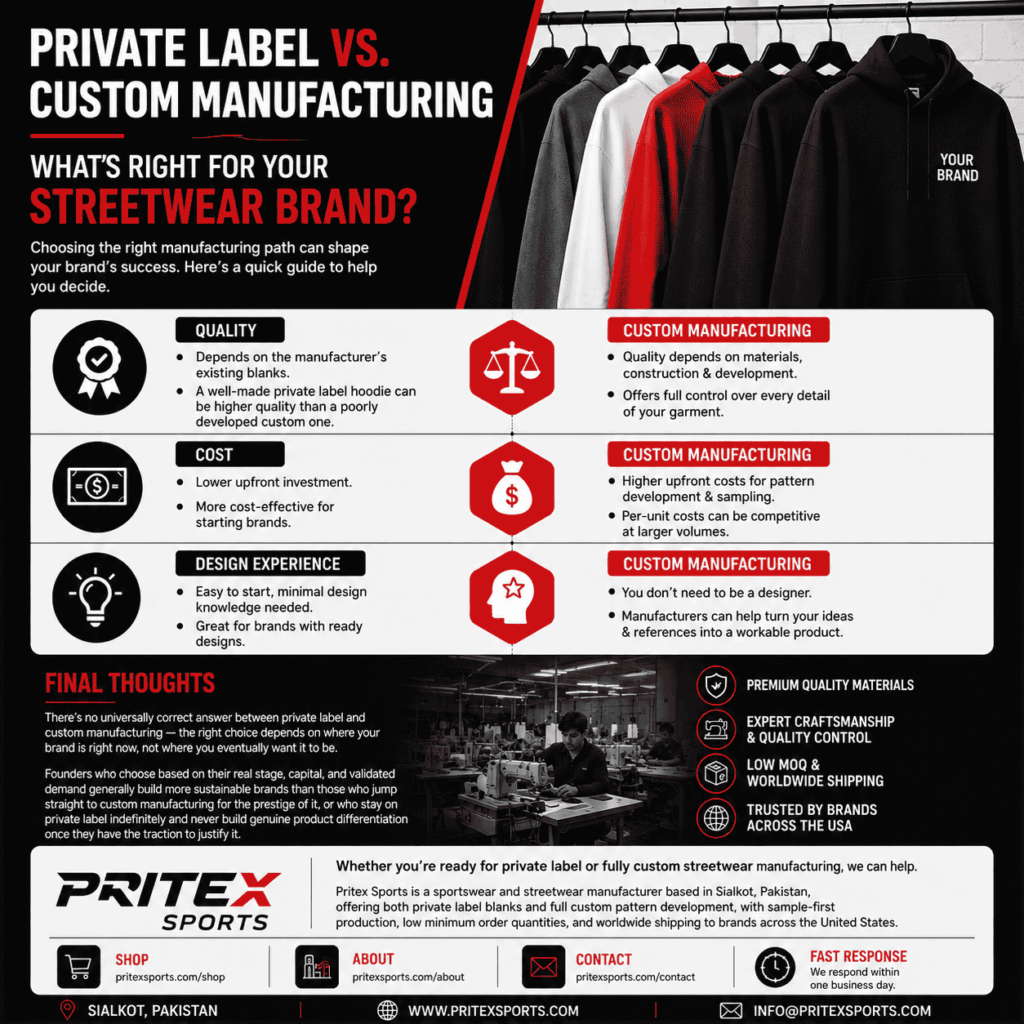
Every streetwear founder eventually hits the same fork in the road: do you private label an existing blank product with your own branding, or do you go fully custom and build every element of the garment from scratch? Both paths can lead to a successful brand, and both have led plenty of founders into expensive mistakes when chosen for the wrong reasons or at the wrong stage.
This guide breaks down exactly what private label and custom manufacturing actually mean in practice, the real cost and timeline differences, and how to figure out which approach fits your streetwear brand right now — not in some hypothetical future once you have more capital. If you’re evaluating manufacturing partners for a custom streetwear line, understanding this decision clearly will save you significant time and money.
1. What Private Label Manufacturing Actually Means
Private label manufacturing means a factory produces a garment using an existing, pre-developed pattern, fit, and construction — a hoodie, a t-shirt, a pair of joggers — and you apply your own branding on top: your logo, your tags, your packaging. The blank garment itself already exists in the manufacturer’s catalog. You’re not designing the fit or construction from the ground up; you’re selecting from what’s already available and making it yours through branding and, often, some limited customization like fabric color or a specific print placement.
This is the model behind a huge percentage of successful streetwear brands, particularly in their early stages. Many well-known streetwear labels started by private labeling a quality blank hoodie or tee, applying strong branding and design, and building an audience — before ever touching custom pattern development.
2. What Custom Manufacturing Actually Means
Custom manufacturing means you’re building the garment from the ground up: your own pattern, your own fit specifications, your own fabric selection, your own construction details. Nothing about the base garment is pre-existing — the silhouette, the exact fit through the shoulders or waist, the specific fabric weight and blend, the panel construction, all of it is developed specifically for your brand through a design and sampling process.
This is a significantly more involved process, requiring pattern development, multiple sample rounds, and generally longer lead times — but it also gives you a product that literally cannot be replicated by simply changing a logo, because the garment construction itself is proprietary to your brand.
3. The Core Tradeoff: Speed and Cost vs. Differentiation
At the highest level, the decision comes down to this tradeoff. Private label gets you to market faster and at lower upfront cost, but your product is fundamentally similar to what other brands using the same blanks are also selling — your differentiation lives entirely in branding, marketing, and design applied on top of the garment. Custom manufacturing takes longer and costs more upfront in development, but the product itself becomes a genuine point of differentiation that’s much harder for a competitor to simply copy by sourcing the same blank.
Neither approach is inherently better — the right choice depends heavily on your stage, your capital, your timeline, and what’s actually going to matter most to your specific customer.
4. Minimum Order Quantities: How They Differ Between the Two Models
Private label MOQs are generally lower because the manufacturer already has the pattern, fabric sourcing, and production process established for that garment — you’re essentially plugging into an existing production line. It’s common to find private label MOQs in the range of 50 to 150 units per style and color, sometimes lower depending on the manufacturer.
Custom manufacturing MOQs tend to be higher, because the factory has to invest time in pattern development, sampling, and setting up a new production process specifically for your design. That said, manufacturers who specifically work with growing and independent brands increasingly offer lower custom MOQs with sample-first production, making custom manufacturing more accessible to smaller streetwear founders than it used to be.
5. Cost Comparison: Where the Money Actually Goes
With private label, your upfront costs are lower because there’s no pattern development or extensive sampling investment — you’re often just approving a branding placement and ordering. Your per-unit cost may be similar to or even higher than custom manufacturing at scale, though, because you’re paying into a standardized production model rather than one optimized specifically for your order size and fabric choices.
With custom manufacturing, you’ll typically pay for pattern development and sample rounds upfront — this is a real cost that private label mostly avoids. But at meaningful production volume, your per-unit cost can become more competitive because the entire production process, fabric sourcing, and construction have been optimized specifically for your product rather than adapted from a generic template.
6. Timeline Differences You Need to Plan Around
Private label is significantly faster. Because the base garment and pattern already exist, you can often move from initial conversation to a branded sample within one to two weeks, and into bulk production shortly after approval. This speed is one of private label’s biggest advantages for founders trying to launch quickly or test a new market.
Custom manufacturing takes longer by design. Expect two to four weeks for pattern development and an initial sample, followed by one or two rounds of revisions, before you’re ready to approve bulk production. Add typical production and shipping time on top of that, and a custom product can easily take six to ten weeks from first conversation to finished inventory in hand — sometimes longer for more complex designs.
7. Which Streetwear Brand Stage Fits Private Label
Private label tends to make the most sense in a few specific situations:
- You’re launching your very first product line and want to validate demand before investing in custom development
- Your brand differentiation is primarily built through graphics, prints, and branding rather than unique garment construction
- You have limited upfront capital and need to keep initial investment as low as possible
- You’re testing a new product category before committing to a fully custom version
- Speed to market matters more than having a completely unique garment silhouette
Many successful streetwear brands never fully leave the private label model for their core basics — hoodies and tees — while reserving custom manufacturing for signature, flagship pieces that define the brand more distinctly.
8. Which Streetwear Brand Stage Fits Custom Manufacturing
Custom manufacturing tends to make more sense when:
- You have a specific, differentiated fit or silhouette in mind that isn’t available as a standard blank
- Your brand’s product itself — not just the branding on top — is central to your positioning and story
- You’ve validated demand already (often through an earlier private label run) and are ready to invest in a signature product
- You need specific technical features — unique panel construction, custom hardware, particular fabric performance — that a standard blank can’t deliver
- You’re building toward wholesale or retail partnerships where a proprietary product gives you a stronger negotiating position
Custom manufacturing is often the natural next step for a streetwear brand that has proven demand with private label products and wants to build something more defensible as competitors start copying the branding-only approach.
9. A Hybrid Approach Many Successful Brands Actually Use
In practice, many of the most successful streetwear brands don’t choose one model exclusively — they use both strategically. Core, repeatable basics like tees and standard hoodies are often private labeled to keep costs and lead times manageable, while flagship or signature pieces — a distinctive cargo pant silhouette, a unique jacket, a specific hoodie cut that becomes associated with the brand — are custom manufactured. This hybrid approach lets a brand move quickly and affordably on its bread-and-butter products while still building genuine differentiation where it matters most.
10. What to Ask a Manufacturer Before Choosing Either Path
Regardless of which model you’re leaning toward, ask your manufacturer directly:
- For private label — what blank styles, fits, and fabric options are currently available, and can I see physical samples of each?
- For custom — what does the pattern development and sampling process look like, and how many revision rounds are typically included before additional charges apply?
- What is the minimum order quantity for each approach, and does it apply per style, per color, or as a combined total?
- What branding methods are available in-house — embroidery, screen printing, heat transfer, woven labels?
- What’s the realistic timeline from approval to finished inventory in my hands in the US?
A manufacturer with in-house departments for both private label blanks and full custom pattern development, like a facility handling streetwear and custom apparel manufacturing under one roof, gives you the flexibility to start with one model and transition to the other as your brand grows, without switching suppliers entirely.
11. Fabric Considerations Across Both Models
Fabric quality matters regardless of which manufacturing path you choose, but the level of control differs. With private label, you’re typically choosing from the fabric options already available for that specific blank — which is fine if the quality meets your standard, but limiting if you have a very specific fabric weight or blend in mind. With custom manufacturing, you have full control over fabric selection: French terry weight for hoodies, specific cotton-poly blends for tees, garment-dyed finishes, or specialty fabrics that aren’t commonly available as standard blanks.
For streetwear specifically, fabric weight and hand-feel are often what separates a product that feels premium from one that feels generic, so this is worth weighing carefully when deciding how much control you actually need over the base material.
12. Branding and Customization Within Private Label
Private label doesn’t mean zero customization — it means customization happens within the constraints of an existing garment. You can typically still choose:
- Fabric color from available options
- Print or embroidery placement and design
- Neck label, hang tags, and packaging
- In some cases, minor construction tweaks like drawstring color or pocket style, depending on the manufacturer’s flexibility
The key limitation is the base pattern and fit itself — you’re working within what the manufacturer already offers rather than defining it from scratch.
13. Risk Considerations for Each Approach
Private label carries lower financial risk per launch, since your upfront investment is smaller and lead times are shorter, which means you can test and iterate faster if a design doesn’t perform well. The tradeoff is brand risk — since the underlying garment is available to other brands using the same blank supplier, a design that becomes popular can be replicated relatively easily by competitors sourcing the same base product.
Custom manufacturing carries higher financial risk per launch, since you’re investing more upfront in development before you know how the market will respond. The tradeoff is stronger long-term brand protection, since a genuinely custom pattern and construction is much harder for a competitor to replicate quickly, even if they try to copy the design visually.
14. How This Decision Affects Your Pricing Strategy
Private label products, because they’re built on a shared base garment, often need to compete more directly on branding, marketing, and price relative to similar products from other brands using comparable blanks. Custom products, because they offer something genuinely unique, can often support a higher price point and stronger margin, provided the design and quality justify it to your customer.
When calculating pricing for either model, remember to build in your full landed cost — manufacturing, shipping, and duties — before setting your retail price, and factor in that custom development costs need to be recovered across your production run, not just treated as a one-time sunk cost you ignore in your margin calculations.
15. Quality Control Differs Slightly Between the Two Models
With private label, quality control is largely about consistency — making sure the blank garment you’re branding meets the same standard every time you reorder, since the base pattern itself is already established and tested. With custom manufacturing, quality control starts much earlier in the process, since you’re validating an entirely new pattern and construction method through sampling before you ever place a bulk order. Ask your manufacturer specifically how they handle quality checks at each stage for whichever model you choose — this is one area where a serious manufacturer will have clear, specific answers rather than vague assurances.
16. Making the Transition From Private Label to Custom Over Time
A common and often smart growth path for streetwear brands looks like this: launch with private label products to validate your brand concept and audience with lower risk, use the sales data and customer feedback from that launch to identify what a truly differentiated, signature product should look like, then invest in custom manufacturing for that specific flagship piece once you have real demand data supporting the investment. This staged approach reduces the risk of investing heavily in custom development for a product that the market ultimately doesn’t want.
17. Common Mistakes Streetwear Founders Make With This Decision
- Jumping straight to custom manufacturing before validating that there’s real demand for the brand at all
- Staying on private label indefinitely even after proving strong demand, missing the opportunity to build genuine product differentiation
- Choosing custom manufacturing purely for the perceived prestige of “custom” without a real product reason for it
- Not budgeting properly for the extra time and cost custom development requires, and getting caught off guard by a longer timeline
- Working with a manufacturer who can’t clearly explain their private label catalog or their custom development process
18. Questions to Ask Yourself Before Deciding
Before committing to either path, it’s worth honestly answering a few questions: Do I have validated demand for this specific product, or am I still testing? Is my differentiation coming primarily from design and branding, or does the actual garment construction need to be unique? How much capital can I realistically commit to development and a first production run? How quickly do I need inventory in hand to hit a launch date? Answering these honestly will usually make the right path fairly clear, rather than defaulting to whichever option sounds more impressive.
Frequently Asked Questions
Can I start with private label and switch to custom manufacturing later with the same factory?
Yes, if the manufacturer offers both models, which allows you to start faster and lower-risk, then move into custom development once you have validated demand and are ready to invest in a signature product.